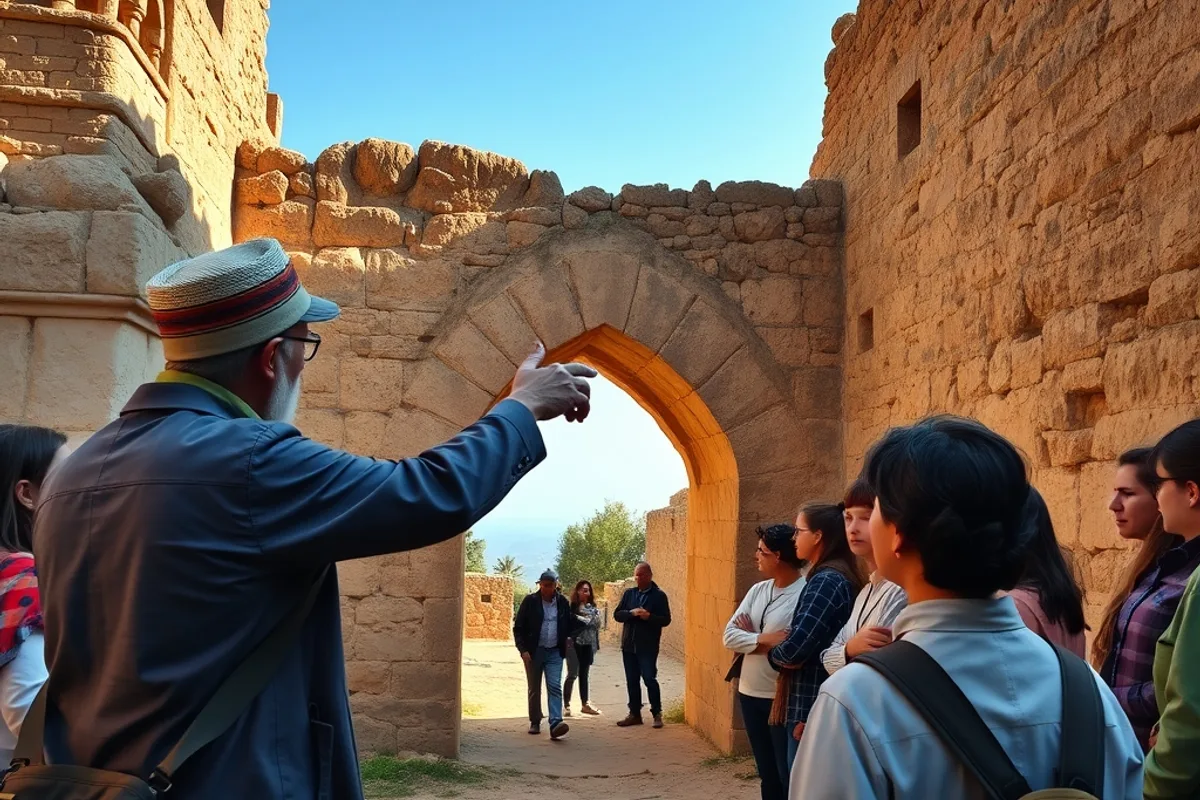
The guide stops in front of a plain stone wall and asks the group what they notice. Nobody says anything. Then she points to a line of bricked-up windows, a change in the stone, a date carved above the arch. For the next ten minutes, the wall becomes a document: a record of a fire, a renovation, a family that once lived there.
That is what a good walking tour does. It does not give you more facts than a guidebook. It gives you a way of looking. The question is whether that is worth the money, and the answer depends on the tour, the guide and what you want from a city.
The free tour paradox
Free walking tours are one of the best inventions of modern city travel, and one of the most misunderstood. They are free in the sense that there is no fixed price. You are expected to tip at the end, usually around ten to fifteen euros for a good tour. The guide is often an independent contractor who pays the company a fee per guest.
This model has advantages. It lowers the barrier to entry, rewards good guides, and makes the tour accessible to people on a budget. It also has disadvantages. Guides are under pressure to be entertaining, to keep the group large, and to end near a restaurant or a bar with a commission arrangement. The economics can encourage performance over substance.
None of that makes free tours bad. It means you should choose carefully and tip fairly. A good free tour can be excellent. A bad one can be a two-hour puppet show.
What you are buying
On a good tour, you are buying three things: orientation, context and access. Orientation is practical: how the city is laid out, where the transport goes, which areas are worth returning to. Context is historical and cultural: why the buildings look the way they do, who lived there, what changed. Access is the guide's relationships: a shop, a market stall, a church, a courtyard that you would not find alone.
You are also buying a filter. A city has more information than you can process. A guide chooses what matters and sequences it. That is valuable, especially on a short trip.
What you are not buying is a guarantee of truth. Guides simplify, repeat myths and sometimes get things wrong. A good guide will tell you when a story is contested. A bad one will present legend as fact.
The guide matters more than the route
The same route can be transformed by a good guide or ruined by a bad one. Look for guides who ask questions, who admit uncertainty, who connect the past to the present, and who are interested in the group. Avoid guides who perform outrage, make everything about a single conspiracy, or spend more time on personal anecdotes than on the place.
Read reviews for the guide's name, not just the company. Good companies cultivate good guides, but the experience is individual. If a guide is repeatedly praised for being knowledgeable and generous, that is a strong signal.
Group size matters. A group of thirty is a lecture; a group of ten is a conversation. Smaller groups cost more, but they are usually worth it.
Small groups and strange hours
The best tours often run at inconvenient times: early morning, late afternoon, or on a weekday when the sites are quiet. They may avoid the famous square entirely and spend an hour in a residential neighbourhood. They may focus on a single theme — food, architecture, labour, music — rather than trying to cover everything.
Theme tours are usually better value than general tours, because they have a clear point of view. A food tour that visits three producers and explains the supply chain is more useful than one that offers twelve tastings in five locations. An architecture tour that teaches you to read a facade will change how you see the rest of the city.
When to walk alone
Some cities do not need a guide. If you have time, a map and a willingness to get lost, walking alone can be more rewarding. You can stop when you want, linger, revisit, and follow your curiosity. Audio guides and podcasts can fill in the context without committing to a group.

The ideal is a combination: one good tour early in the trip to get oriented, then independent walking. The tour gives you a framework; the walking gives you the experience. Neither replaces the other.
The test of a good tour
A good tour ends with you knowing where you are. Not just the geography, but the logic of the place: why the market is there, why the rich lived uphill, why the station faces the wrong way. It gives you a handful of stories you will repeat, and a list of things you want to see again.
It also leaves you with a sense of obligation: to the guide, to the place, and to the people who live there. That is worth more than the fee. But the fee is how the guide pays the rent, so pay it properly.